


SINCE 1973
TENUTA DI TAVIGNANO
Tenuta di Tavignano was acquired in 1973 by Stefano Aymerich di Laconi, of Sardinian and Spanish origins, and by his wife Beatrice Lucangeli, descendant of a family from Marche with an ancient tradition in the production of wine. Tavignano is an estate of 230 hectares in a single body that dominates the countryside of Cingoli, which has always been known as the “Balcony of Marche”. The estate is located within the prestigious territory of Verdicchio dei Castelli di Jesi, Tavignano being one of the Castles of the denomination.
The estate was renovated with a careful conservative restoration, respecting the authenticity of the place and, in the early years, the company concentrated on the cultivation of cereals, vegetables and forage.
In the 90s the couple took the decision to enhance the present wine heritage and become producers of native varieties, in contrast with the trend of the time that favored international ones. However, Stefano and Beatrice were certain of the great potential of the main grape of these lands: Verdicchio.
Giancarlo Soverchia, a professional of the wine sector, decided to explant the existing vineyards at the time and to adopt the spurred cordon with Verdicchio in order to obtain its maximum expression. Under his wise guidance, the choices were consistent with the personality of the owners, aimed at enhancement of quality and territoriality.
Since 2004 the two founders took the choice, with great satisfaction, to follow the consultancy and advice of the oenologist and wine maker Pierluigi Lorenzetti. In 2006 the first important recognition arrived: the three glasses of Gambero Rosso for Misco Riserva.
From 2014 Ondine de la Feld has entered the company to support her uncle Stefano Aymerich in managing its business, adding a modern, dynamic and entrepreneurial style with the help of a young and motivated team, committed to face the challenges of the future; a breath of new energy in the name of continuity
In the same year, the conversion of all the vineyards to organic farming began: today, fertilization is organic and green manure is practiced.
In 2015, thanks to Ondine and with the help of Tavignano’s Team, the “natural” line “I love Monsters” took shape.
In 2017, Misco 2015 Verdicchio dei Castelli di Jesi DOC Classico Superiore, the most representative wine of Tavignano, was nominated by Gambero Rosso 2017 Guide as the Best White Wine in Italy. Still nowadays Tavignano continues to bet a lot on Verdicchio dei Castelli di Jesi, and this award is a pride for the company but also for the whole DOC of Castelli di Jesi.
Since 2018 the company has been certified organic both at the level of the vineyards, olive groves and arable land as well as at the cellar level, thus allowing an organic certification on the label.
In 2021 Ondine de la Feld becomes CEO of Tavignano, and at the same time the green turning point begins. The company is conducting an eco-sustainable study program to guide the company towards a sustainable future with the aim of minimizing energy consumption and CO2 emissions.


2021
Ondine de la Feld is the new CEO of Tenuta di Tavignano
2018
The winery gets its first organic certification
2017
Misco 2015 Best White Wine of Italy
2015
The “I Love Monsters” line was created

2014
Conversion to organic farming
1994
Start of Misco production

1973
Purchase of the estate
2021
Ondine de la Feld is the new CEO of Tenuta di Tavignano
2018
The winery gets its first organic certification
2017
Misco 2015 Best White Wine of Italy
2015
The “I Love Monsters” line was created
2014
Conversion to organic farming
1994
Start of Misco production
1973
Purchase of the estate
THE LOCATION
WHERE WE ARE
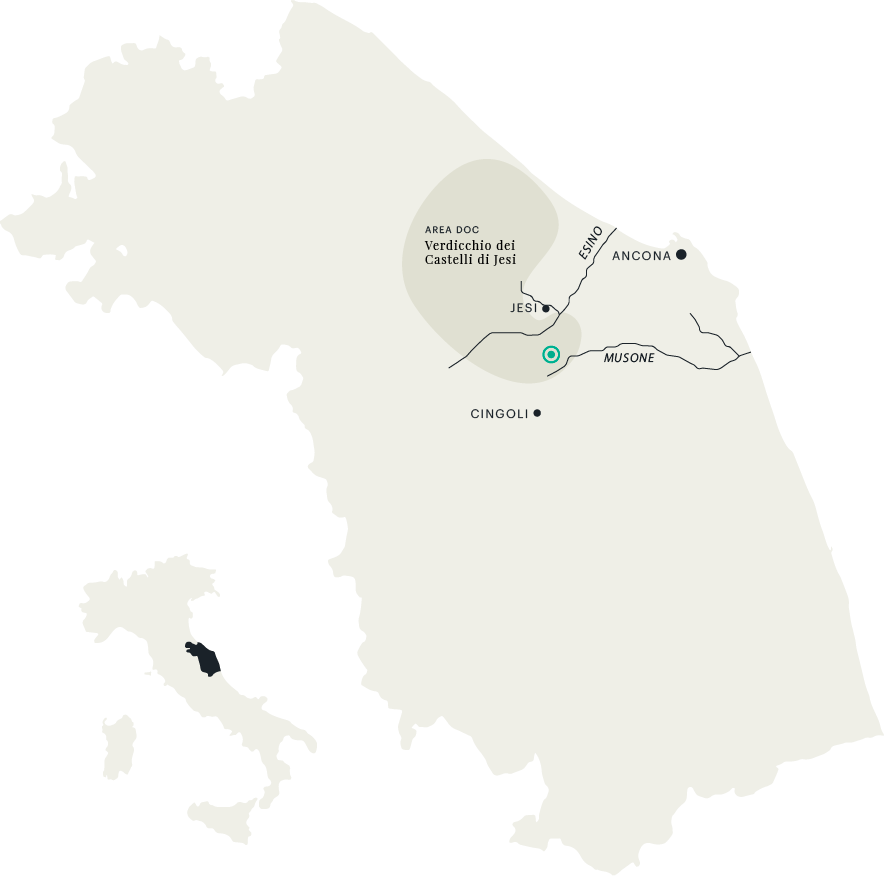
The estate is located at an altitude of 300 m a.s.l. in the municipality of Cingoli, in Macerata’s province, on a hill overlooking the valleys of Esino and Musone rivers. Facing Monte San Vicino on one side and the Adriatic Sea and the Cònero Riviera on the other, in the heart of the classic area of Verdicchio dei Castelli di Jesi, with the peculiarities of the southern side of this DOC. The winery is also within the borders of Rosso Piceno DOC. This privileged position actually creates the uniqueness of its production context.
THE WINERY
The cellar is our “innovation center” where we jealously keep the secrets of our wine-making process.
It’s a modern and innovative structure itself, excavated underground, beneath a hill, totally rebuilt in 2005 and extended too, counting today an area of 500 square meters.
The barrels’ room, located in the ground-basement floor of the historical villa, includes French oak barriques and large Slavonian oak barrels, ranging in size from 15 to 25 hectoliters.
All the operations of the wine-making process are aimed at preserving the original characteristics of the grapes. The vinification of white wines is carried out, first of all, with a soft pressing of the grapes and then, the fermentation takes place at a controlled temperature. To keep the typical varietal characteristics of each grape, we prefer aging in stainless steel tanks on fine lees for all white and rosé wines. None of the estate’s white wines macerates on the skins, with the exception of “La Vergine” from the “I Love Monsters” line. The red wines come from a long fermentation in contact with the skins, successively malolactic fermentation for almost all of them and finally different aging periods in big barrels or barriques of 2nd and 3rd passage.


CURIOSITY
About curiosities, we are going to tell you an ancient legendary story which is rich in charm and has passed on from generation to generation till nowadays.
Once upon a very remote time, in sunny southern lands, the vine was a simple ornamental plant, luxuriant in its bright green foliage, but absolutely unable to produce flowers and fruit.
One spring of many centuries ago a farmer, realizing how much that plant gave shade to the sown lands, decided to drastically prune it to reduce its foliage as much as possible.
A few branches left, short and gnarled, survived such an energetic treatment. The green and leafy plant had been reduced to her own shadow. Looking at herself so horribly mutilated, the vine began to cry tears of bitter despair and suffering. A nightingale, who used to rest at sunset among her green foliage, saw her in those conditions, took pity on her and told her: “Don’t cry… now I will sing for you and the stars will certainly move with compassion.”
The nightingale fluttered among those poor, stunted branches, landed with his paws on one of them, and at nightfall he let the sweetest song flow from his tender throat. He did so for ten nights in a row. Those vibrating notes of feeling had the strength to move the sky. The stars, touched, thus let some of their energy descend on the poor plant mortified by the man. The vine felt herself quivering in every fiber and it seemed to her as if a new lymph had come to give it vigor. The knots of her branches swelled, the buds opened and the green leaves offered themselves to the gentle breath of the wind, while tender green curls, the tendrils, flexed towards the nightingale, wrapping its small legs in a silent caress. Her tears, as beautiful as oriental pearls, gradually turned into many small juicy berries and, at sunrise, the first bunches of grapes were already hanging from the branches. Having rediscovered her ancient appearance, however, the vine realized that she was no longer a sterile plant: from her branches sprouted fruits that possessed the strength of the stars, the sweetness of the nightingale’s song and the luminous grace of splendid summer nights.